
Heat source & timing
Equipment type, rejected heat temperatures, capacity and winter operating schedules establish the available energy.
Explore whether energy already rejected by your HVAC systems can serve a hydronic snow-melt system at your property.
For commercial building owners, developers and facility operators planning entrances, walkways, ramps and other critical outdoor areas.
EEB assesses heat availability and snow-melt demand, then develops the engineering solution around operating conditions, equipment and site constraints.
Request a Snow-Melt Assessment →EEB’s innovative HVAC energy-recovery technology, with a patent application in progress.
Conceptual schematic for illustration · Not a design drawing
Equipment type, rejected heat temperatures, capacity and winter operating schedules establish the available energy.
Slab area, design conditions, construction, insulation and controls determine the snow-melt demand.
Heat exchangers, fluid circuits, pumping, controls and any supplementary heat are evaluated as part of the system.
Recovery does not mean zero operating energy. Performance and savings depend on usable heat coinciding with demand, system efficiency and the comparison baseline.
Send EEB your location, approximate snow-melt area, HVAC equipment information and available drawings. We will define an appropriate assessment scope.
Discuss your snow-melt project →Technical feasibility · Heat availability and load assessment · System design and coordination · Controls sequence · Energy and potential savings calculations · Permit documentation and review as scoped
We can assess relevant program pathways and prepare technical documentation where eligible. Snow-melt technology is not automatically eligible for funding.
Explore energy incentive support →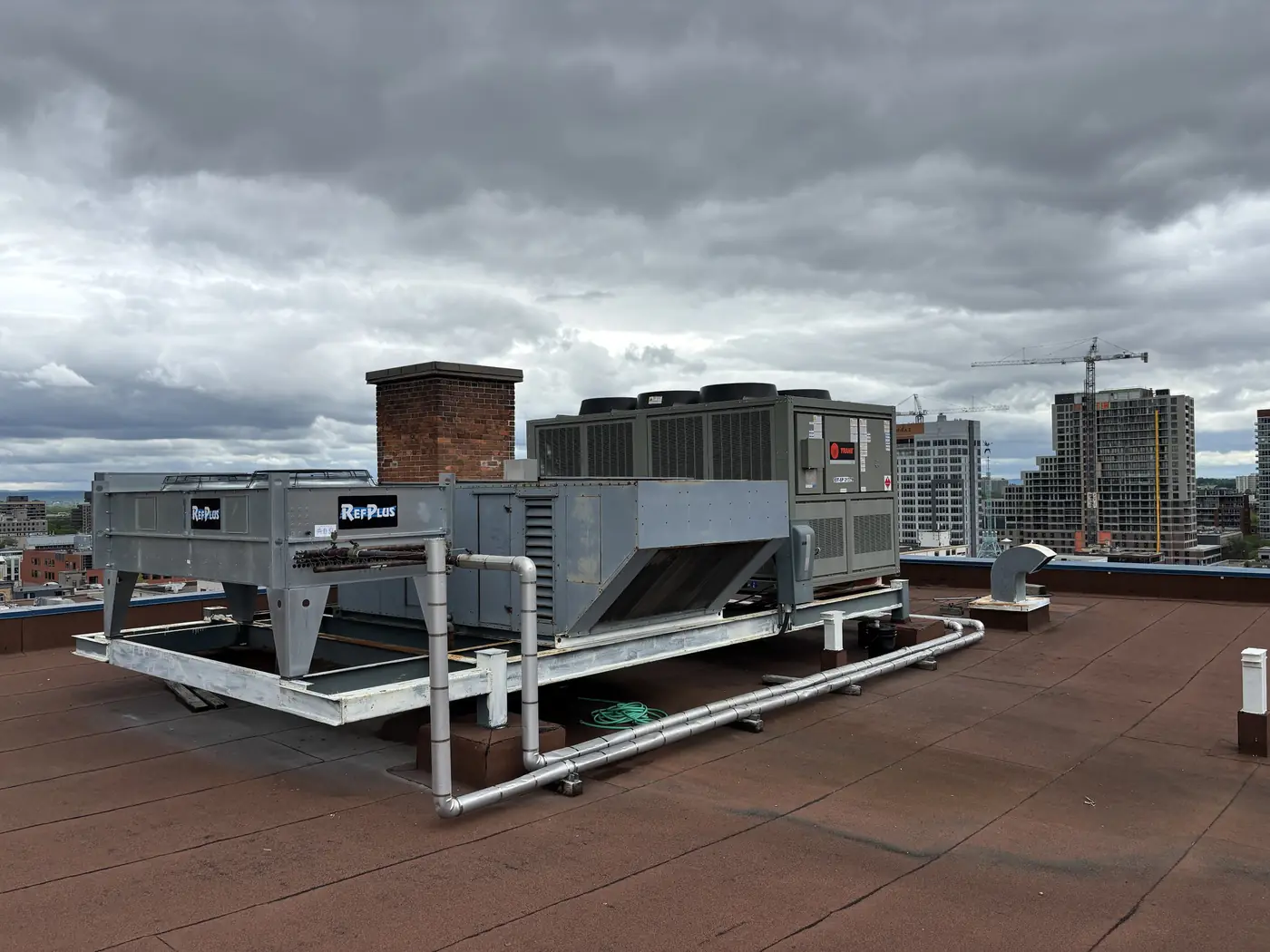
Refrigeration systems for walk-in coolers, freezers and food retail run all winter, and every unit on the roof rejects that heat to outdoor air. EEB evaluates whether it can be captured and moved to a snow-melt loop where it is needed.
Potentially. EEB evaluates equipment compatibility, available heat, piping routes, controls and the outdoor works required before recommending a design.
No. Winter equipment operation and simultaneous demand must be assessed. Supplementary heat or other operating strategies may be required.
It may be suitable where temperatures, demand and system configuration align. EEB evaluates the application and separation requirements within the project scope.